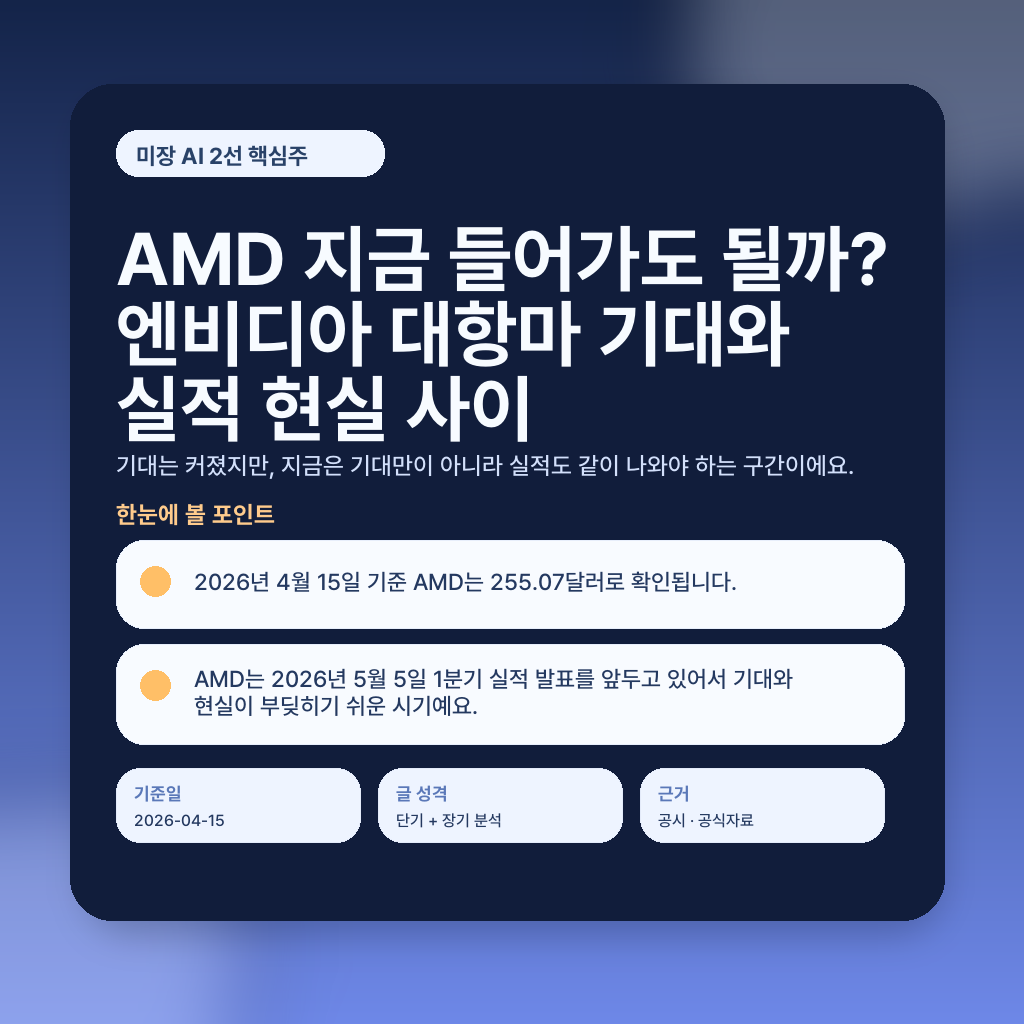
AMD will always be compared with Nvidia, but calling it a mere “challenger” undersells how large the company has become. Data center, AI GPUs, EPYC server CPUs, client — the numbers are genuinely showing up across the board. 🤖
That still does not make today an easy entry. The market’s demand of AMD grows louder by the quarter: if you are an AI beneficiary, prove it in earnings.
As of April 15, 2026, this piece lays out where AMD sits, why the long-term hope persists, and why near-term earnings verification matters so much.

Pairs well with this article
Monitor Light Bar That Cuts Eye Strain
💬 One-line tip: late-night chart and filing sessions get noticeably kinder once you fix the ambient lighting alone.
✨ Key takeaways
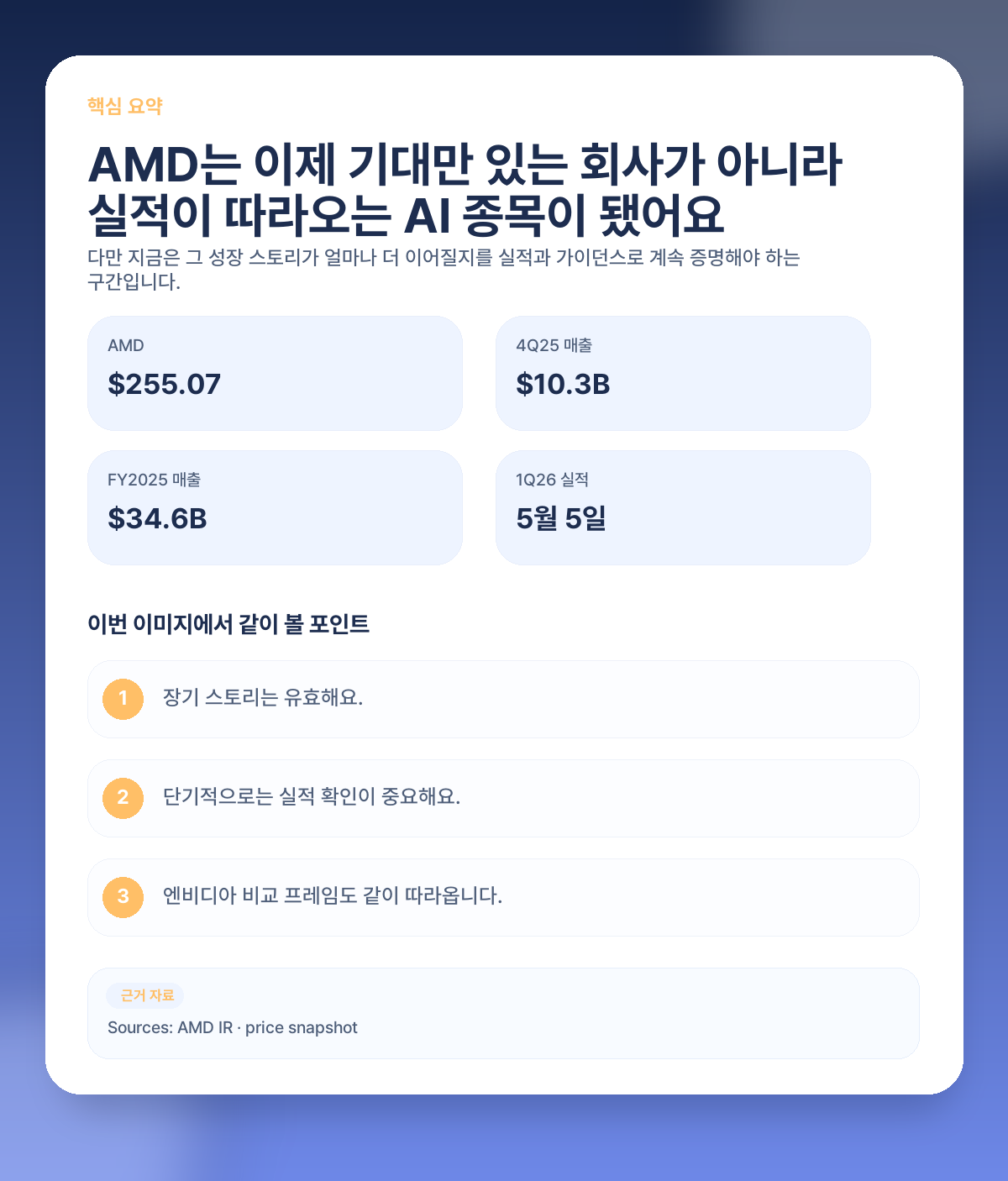
Up front: AMD has passed the “only potential” stage. FY2025 revenue of $34.6 billion was a record, and Q4 2025 revenue of $10.3 billion set one too.
But the stock already prices in much of that story, so from here the market grades the quality and durability of growth more strictly than the narrative itself. AMD is a name with hope remaining and verification demands matching it.
- Long-term strength: data center and AI GPU now carry real weight.
- Short-term strain: it must keep clearing the bar set by Nvidia comparisons.
- Practical point: the May 5 earnings window will drive the interpretation.
📊 Where AMD stands right now
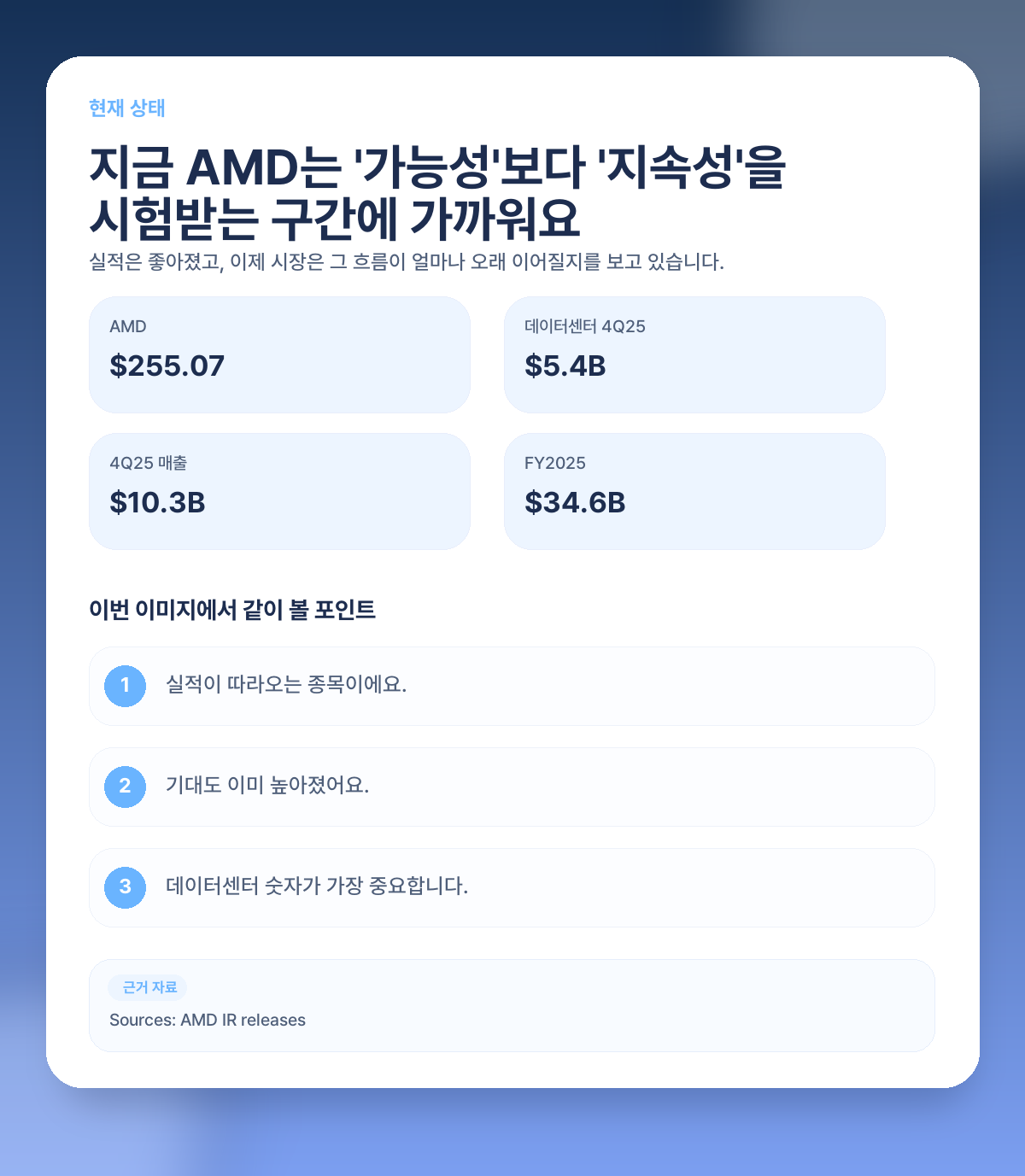
On April 15, 2026 AMD traded at $255.07. Judged on price alone the stock has run a long way, and the market no longer reads it as “just an okay semiconductor name” — it has its own slot inside the AI beneficiary framework.
The official Q4 2025 release shows quarterly revenue of $10.3 billion and full-year revenue of $34.6 billion. Data center revenue for Q4 2025 alone was $5.4 billion, up 39% year over year, with EPYC and Instinct GPUs the core drivers.
AMD has therefore crossed from “could it work out?” to “it is working out — can it hold this speed?”
- AMD is now an AI stock whose earnings follow the story.
- But bigger expectations mean bigger verification pressure.
- The data-center line remains the number that matters most.
🧠 Why the long-term bet is still on the table
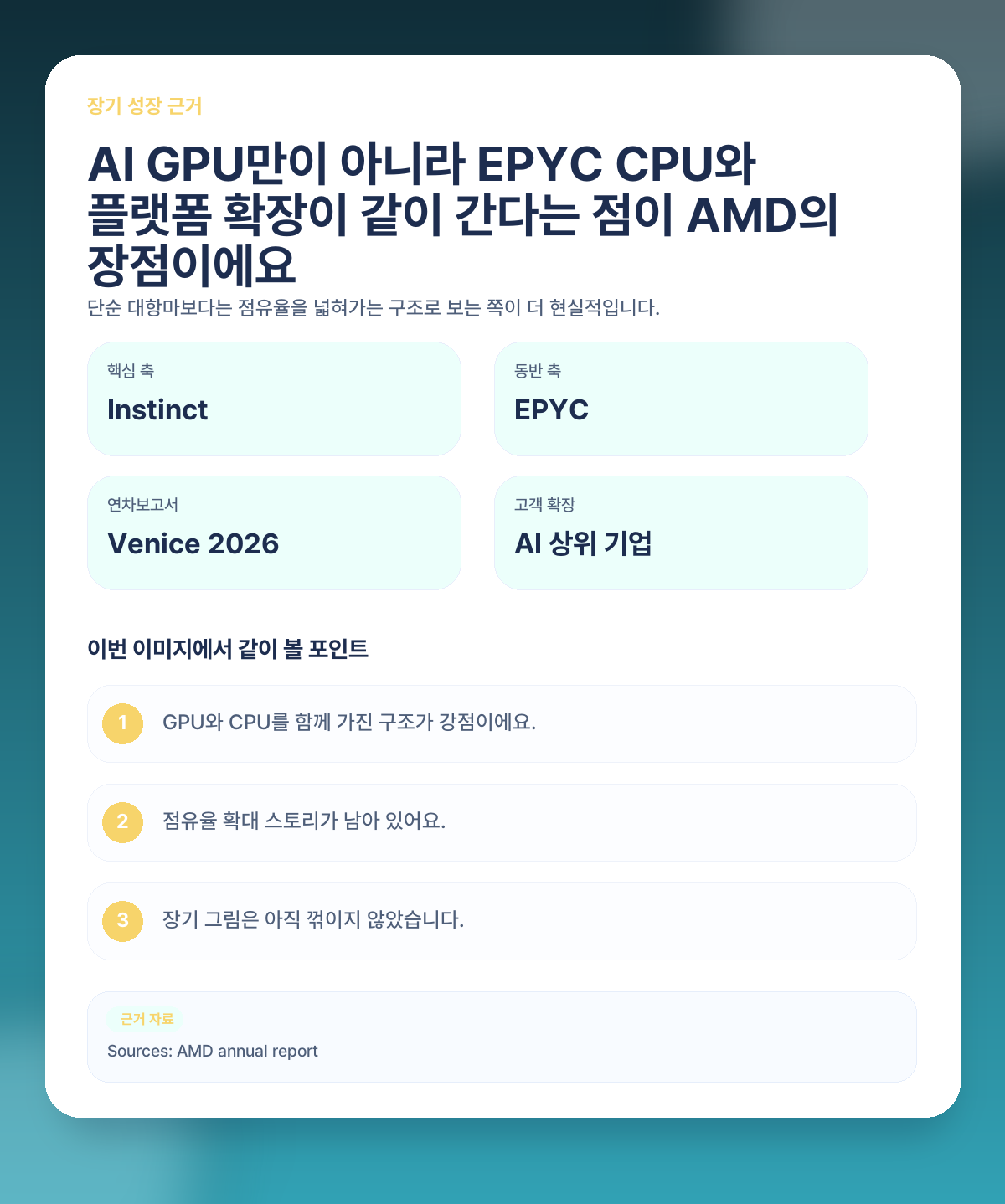
The long-term case is not AI GPUs alone — it is the way CPUs and platforms interlock with them. AMD’s 2025 annual report highlights the 2026 Venice launch, the Instinct roadmap expansion and a widening roster of top AI customers.
Unlike Nvidia, AMD is not the single vessel for every AI expectation; instead it reads as the company slowly taking share. Long term, that is a rather attractive character.
And because AMD pushes EPYC CPUs and rack-scale solutions alongside GPUs, the beneficiary surface widens as AI infrastructure broadens — possibly wider than the headline “GPU race” implies.
- Owning both AI GPUs and server CPUs is structural strength.
- The broader the customer base, the more share-gain runway.
- Long term, “room to grow from second place” beats “handicapped by being second.”
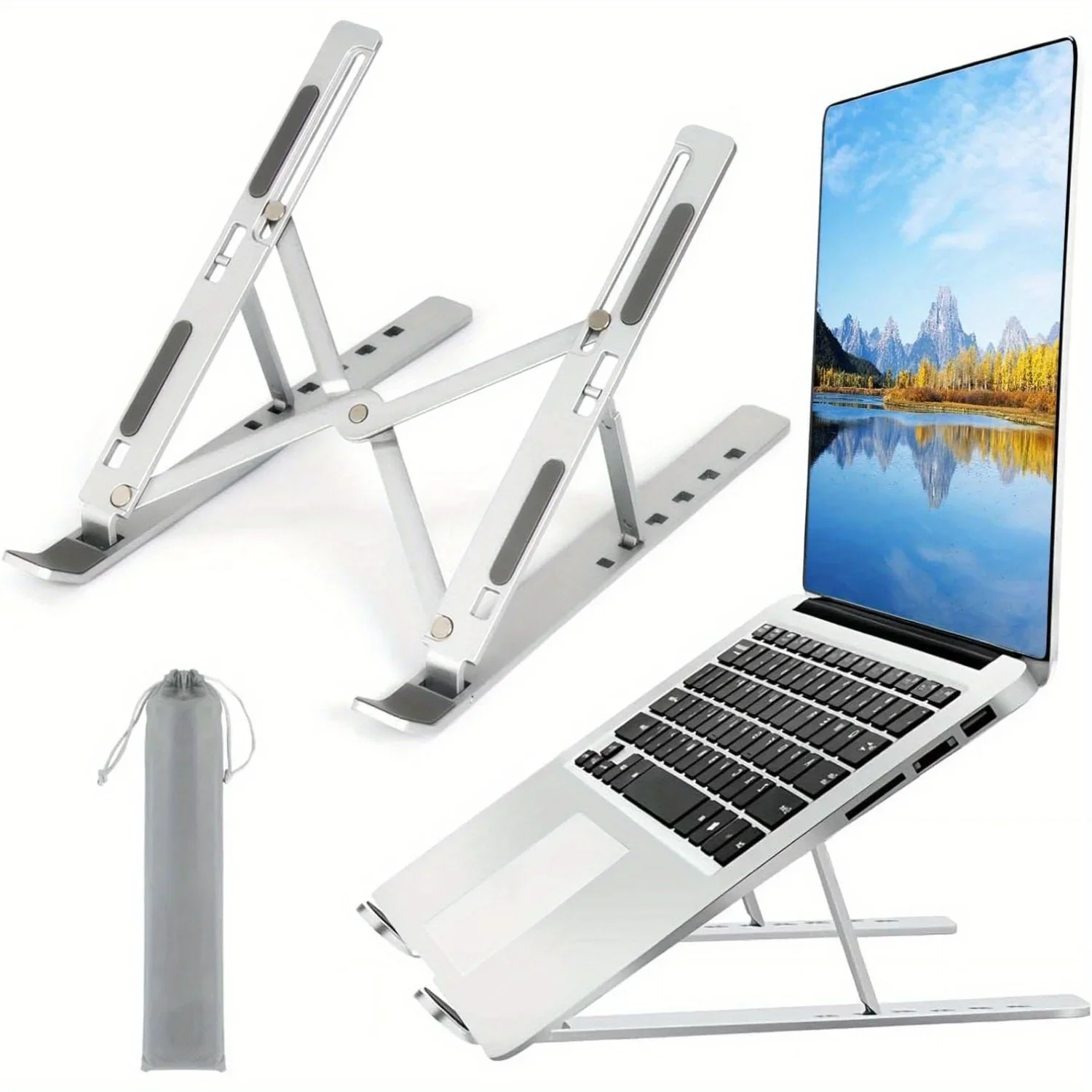
Pairs well with this article
Laptop Stand That Makes Long Sessions Easier
💬 One-line tip: raising your eye line just a little cuts intraday fatigue more than you would expect.
⚠️ Why earnings verification always dominates the short term

First, the Nvidia comparison frame. Even when AMD prints good results, the follow-up question is “is it as fast as Nvidia?” Good alone is often not enough; it has to beat the already-elevated street expectation for the stock to respond strongly.
Second, AI-GPU business volatility. In 2025 AMD lived through export-control issues around the MI308, with inventory charges and reversals. Headlines like that move quarterly numbers more than most people expect.
Third, the May 5 Q1 report. Expectations have risen ahead of the print, so how firmly data-center growth and guidance hold will matter enormously.
- The Nvidia comparison never leaves the room.
- Regulation and inventory can swing the AI GPU line.
- Expectations overbuild ahead of earnings.
✅ The sensible way to approach AMD now

AMD is absolutely worth owning long term, but near term it is earnings-check-first. That argues for splitting entries around the report rather than one large commitment.
Especially when AI-stock expectations run hot across the board, even great companies can see their story re-rated on a single print. Read guidance, customer expansion and data-center margins with the same attention as the headline number.
The balanced summary: a live long-term story attached to short-term timing that is trickier than it looks.
- The long view is valid; tread carefully around earnings.
- Tranches lower the difficulty rating.
- Read the numbers and the commentary together.
📌 Points to keep checking

Next: in the May 5, 2026 Q1 report, look first at data-center growth, the Instinct GPU trajectory and guidance.
Then watch how much Venice and the next-gen Instinct platforms convert into actual revenue, and whether AMD’s customer wins versus Nvidia are accelerating.
- Whether data-center growth holds in the 1Q26 print
- Whether Instinct and EPYC grow together
- Whether guidance keeps pacing market expectations
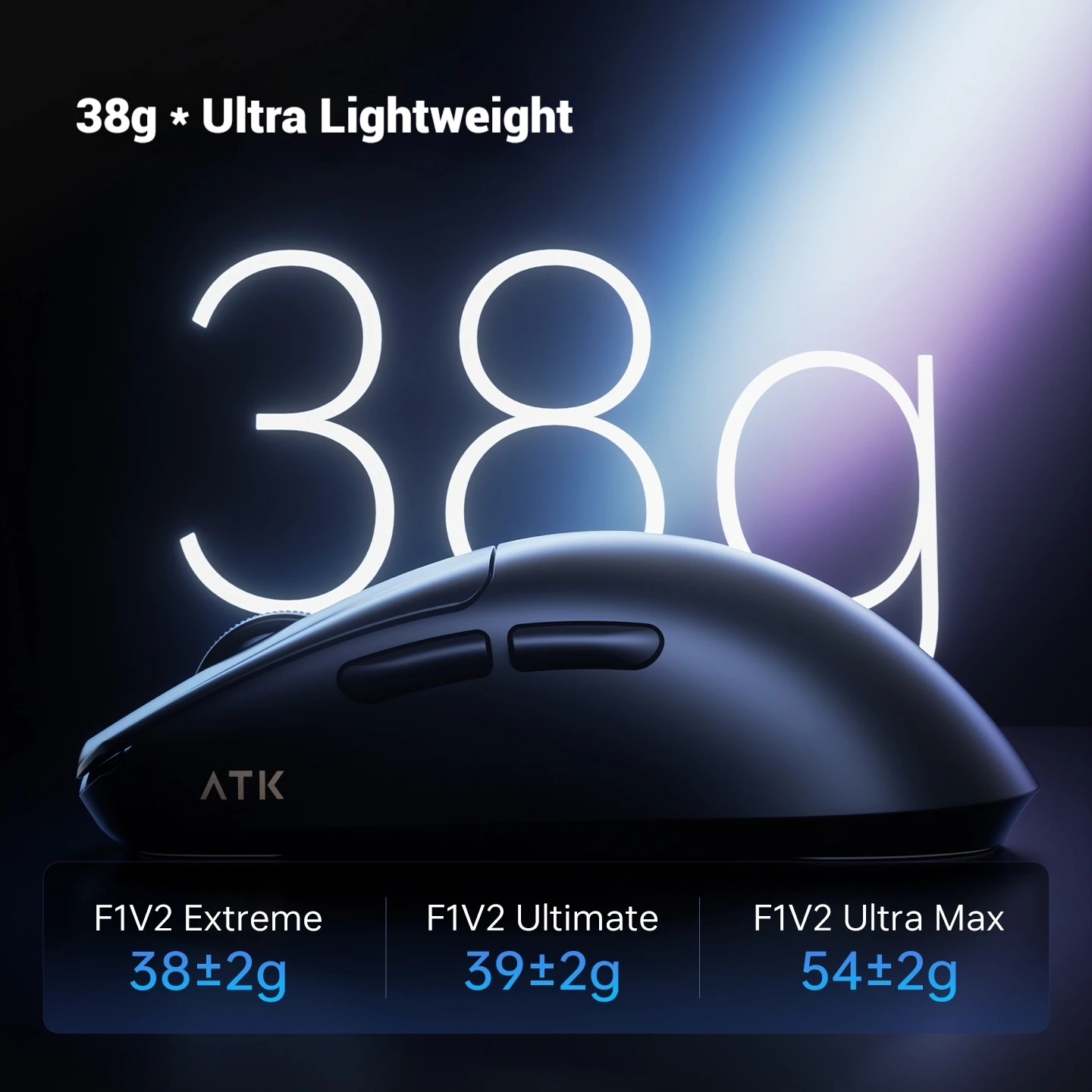
Pairs well with this article
Wireless Mouse Built for Notes and Chart Switching
💬 One-line tip: if you live between charts, notes, and browser tabs, the right basic tool is felt more than you’d think.
🙋 FAQ

❓ Is AMD still the Nvidia alternative?
Yes — but “alternative” undersells it. It is more accurate to read AMD as a player widening its share within AI infrastructure.
❓ Did I miss the boat?
The stock has risen a lot, true, but the long-term story has not ended. Just slow the pace into earnings.
❓ Should my approach differ around earnings?
Yes. Before the print, expectations inflate and volatility is high; after it, entering on confirmed numbers and guidance is usually the calmer path.
❓ Which AMD number matters most?
Data-center revenue and AI-GPU commentary, decisively. The market ultimately times the long-term story off those figures.
🔎 Public sources referenced